Florence Italy Food: The Dishes to Eat and Where to Find Them
Florence cooking is a short list done extremely well. Here is each signature dish, the rooms that serve it best, when those rooms are open, and whether you need a booking or just a willingness to queue.
Short answer
Eat bistecca alla fiorentina, lampredotto, ribollita, handmade pici, schiacciata and gelato. Bistecca runs about EUR 40-60 per kilo (checked September 2026), a lampredotto panino at Da Nerbone costs EUR 5 (checked September 2026), and the scheduling problem is real: several of the best kitchens are lunch-only, cash-only or closed Sundays.
Florence does not have a long menu. The city's cooking is cucina povera, poor kitchen food built on bread, beans, offal, cheap cuts and olive oil, and the dishes that survived are the ones worth crossing town for. The catch is scheduling. The four or five signature dishes of Florence Italy food are scattered across kitchens with completely different opening patterns: one is lunch-only and cash-only, one is dinner-only with a card guarantee, one is a market counter that shuts at 14:00, and one is a sandwich line that moves all day. This guide takes each dish in turn and gives you the three things you actually need: where it is served well, when that place is open, and whether you can walk in.
What are the signature dishes of Florence?
The signature dishes of Florence are bistecca alla fiorentina, lampredotto, ribollita and pappa al pomodoro, handmade pici and other fresh pastas, schiacciata bread, and gelato, plus trippa, peposo and cantucci alongside them. Each belongs to a different kind of room, from a market counter to a candlelit cellar, and each has its own opening rhythm.
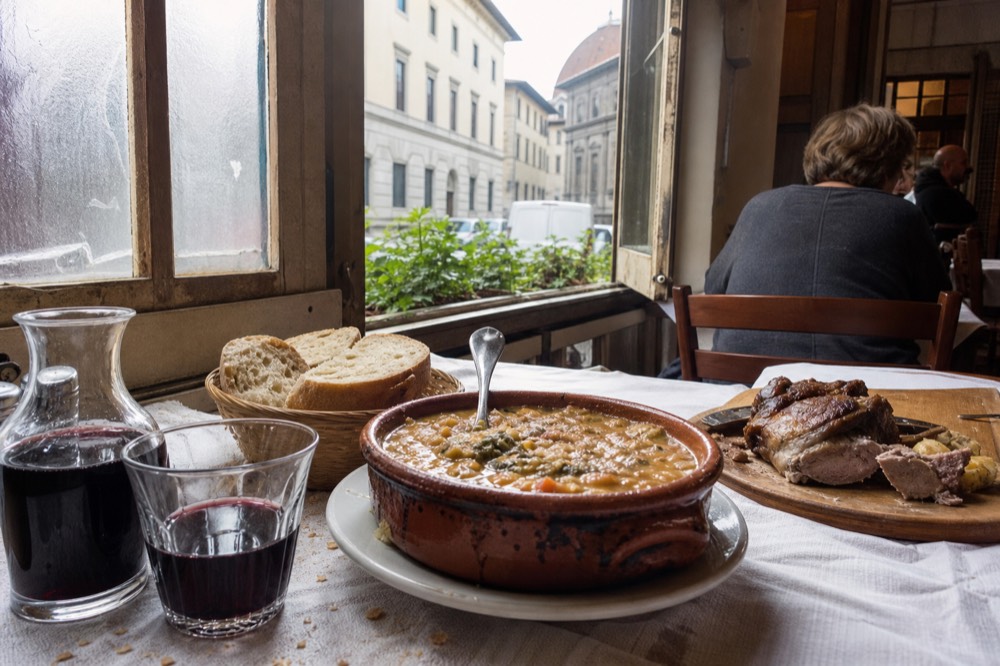
The list is short because the tradition is strict. Florentine cooking grew out of peasant households, so its classics are built on what the countryside produced cheaply: stale bread turned into ribollita and pappa al pomodoro, organ meats turned into lampredotto and trippa, beans, game, and the big Chianina steer that could feed a family for days. A visitor eating well in Florence is mostly eating dishes that are centuries old, in rooms that have not changed much either.
That is also why the practical side matters more here than in most cities. The kitchen that makes the best ribollita may only serve lunch. The steakhouse you want opens at 19:00 and takes no walk-ins after 19:30. The gelateria closes on Mondays. Plan the dishes, then plan the clocks, and Florence becomes the easiest food city in Italy. For the broader restaurant landscape, our Best Restaurants in Florence coverage goes dish by dish and room by room, and the street food and lampredotto guide expands on the counters.
Where should you eat bistecca alla fiorentina?
The best bistecca alla fiorentina is served at Trattoria Sostanza, a cash-only, phone-only room near Santa Maria Novella, at Buca Mario, which serves dinner only from 19:00 Monday to Saturday, and at Regina Bistecca near the Duomo, the one steakhouse where you can book online. The steak is a T-bone cut from the loin, served rare and priced by weight.
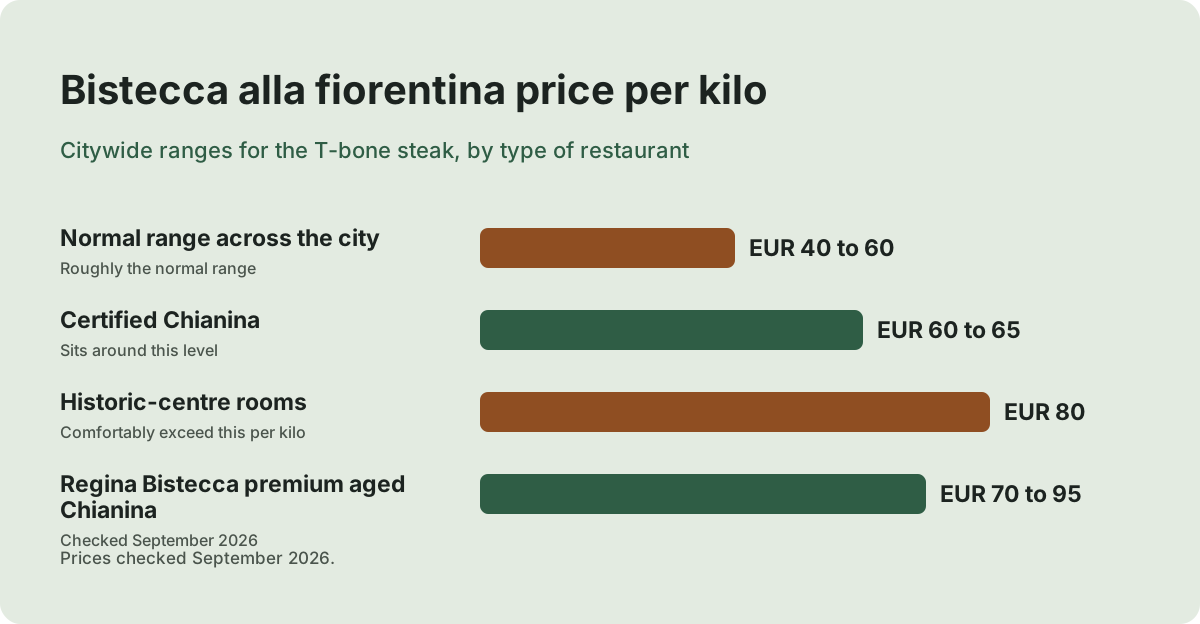
The dish itself is specific. It is the lombata, the loin on the bone, with the fillet on one side of the bone and the sirloin on the other. It is traditionally cut three to four fingers thick, roughly 5 to 6cm, and a restaurant steak typically weighs between 0.9kg and 1.2kg. It is grilled over wood or charcoal and served rare, around 50C internally, and never well done. The traditional breed is Chianina, one of three central Italian breeds covered by the Vitellone Bianco dell'Appennino Centrale IGP designation, though no law requires a restaurant to use that meat to call the dish a fiorentina. You can read the consortium's own description at vitellonebianco.it.
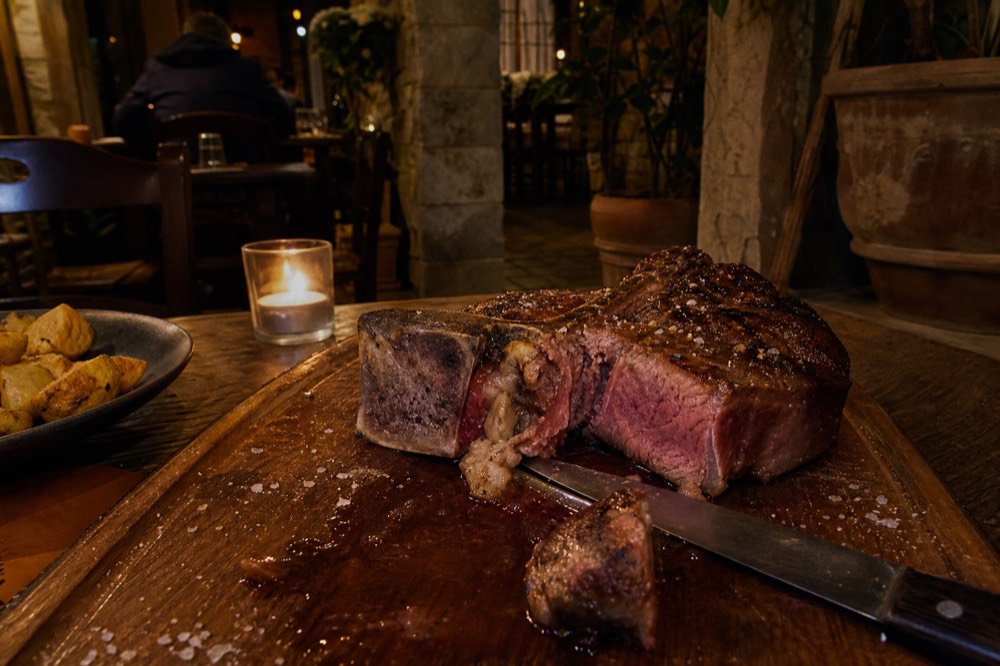
Price is by the kilo and the band is wide. Roughly EUR 40 to 60 per kilo is the normal range across the city, certified Chianina sits around EUR 60 to 65, and historic-centre rooms comfortably exceed EUR 80, while Regina Bistecca's premium aged Chianina runs EUR 70 to 95 per kilo (checked September 2026). One steak is for two people: it is a single cut, never portioned before cooking, and eating one alone is possible but unusual. Our full bistecca alla fiorentina guide covers the cut, the breed rules and the pricing in depth.
| Restaurant | Booking | Hours and days | Notes |
|---|---|---|---|
| Trattoria Sostanza | Phone only, call a week or more ahead | Lunch and dinner, two sittings, closed Sunday | Cash only |
| Buca Mario | Phone or site form, card guarantee | Dinner only, Mon-Sat from 19:00, closed Sunday | A line forms before the door opens |
| Regina Bistecca | Online booking | Lunch daily 12:00-15:00, dinner 19:00-23:00 | EUR 70-95/kg for premium aged Chianina (checked September 2026) |
The scheduling lesson is that steak is a dinner problem, and dinner in Florence starts late. Service generally begins between 19:30 and 20:00, and Florentines eat around 20:00 to 21:00, so a good trattoria is not full until after 20:15. Tourist-facing places in the centre open around 19:00, and turning up at 18:30 simply filters you towards whichever room has already opened, which is exactly the wrong filter. If steak is the goal, book a 20:00 table and take the line at Buca Mario as part of the experience.
Where do you find the best lampredotto?
The best-known lampredotto counter is Da Nerbone on the ground floor of Mercato Centrale, open Monday to Saturday from 09:00 to 14:00, where the lampredotto panino costs EUR 5 and the bollito panino EUR 6 (checked September 2026). It is walk-in only, cash and card both fine, and closed Sunday. Tripperia Pollini near Sant'Ambrogio is the other name to know.
Lampredotto is the fourth stomach of the cow, slow-cooked with herbs and served in a bread roll, often with its own cooking broth on the side for dunking. It is the most Florentine food there is, a working-class lunch that predates every restaurant on the tourist circuit, and it is still mostly eaten standing up. Stanley Tucci ate it on camera at Tripperia Pollini in the 2025 series Tucci in Italy, which has added a queue to a cart that never had much of one before.
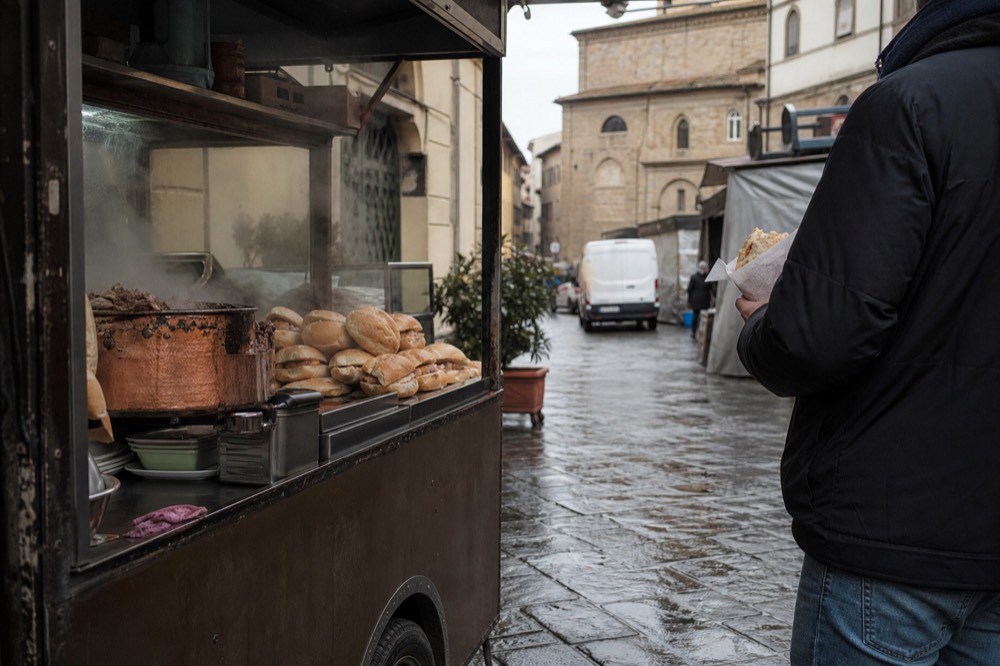
The clock matters more than the choice of cart. Da Nerbone stops at 14:00, and the whole ground-floor market around it runs Monday to Friday 07:00 to 15:00 and Saturday 07:00 to 17:00, closed Sunday. The food hall upstairs is a different operation entirely, open every day 09:00 to 23:00, so a Sunday-afternoon visitor finds only the upstairs. If you want the historic market atmosphere with your lampredotto, go on a weekday morning, and see our market-by-market breakdown of the building's two floors for the full split.
| Counter | Panino price | Hours | Closed |
|---|---|---|---|
| Da Nerbone, Mercato Centrale | EUR 5 lampredotto, EUR 6 bollito (checked September 2026) | Mon-Sat 09:00-14:00 | Sunday |
| Tripperia Pollini, Sant'Ambrogio area | On the cart, check on the day | Daytime cart service | Varies by season |
| Semel, Piazza Ghiberti | On the board | Mon-Sat 11:30-14:30 | Sunday |
Semel is the third stop worth knowing: a tiny sandwich shop by Sant'Ambrogio market with inventive daily fillings, open only 11:30 to 14:30 and closed Sundays, with almost nowhere to sit. It is a lunch-only city within a lunch-only tradition. If your lampredotto day is a Sunday, your realistic option is a food hall counter upstairs at Mercato Centrale rather than the historic stalls below.
Where is ribollita and pappa al pomodoro served best?
Ribollita and pappa al pomodoro are at their best at Trattoria Mario near Mercato Centrale, which serves lunch Monday to Saturday, takes phone bookings only in the morning, is cash-only and closes on Sundays, and at Osteria Cinghiale Bianco in Borgo San Jacopo, which opens at 18:00 on weekdays and adds lunch at weekends.
Both dishes are bread soups, and both exist because Tuscany never threw bread away. Ribollita is yesterday's minestrone reboiled with stale bread until it is thick as porridge; pappa al pomodoro is bread simmered with tomato, olive oil and basil. They are the truest test of a Florentine kitchen, because there is nowhere to hide: a restaurant that serves a good ribollita almost certainly does everything else well too.
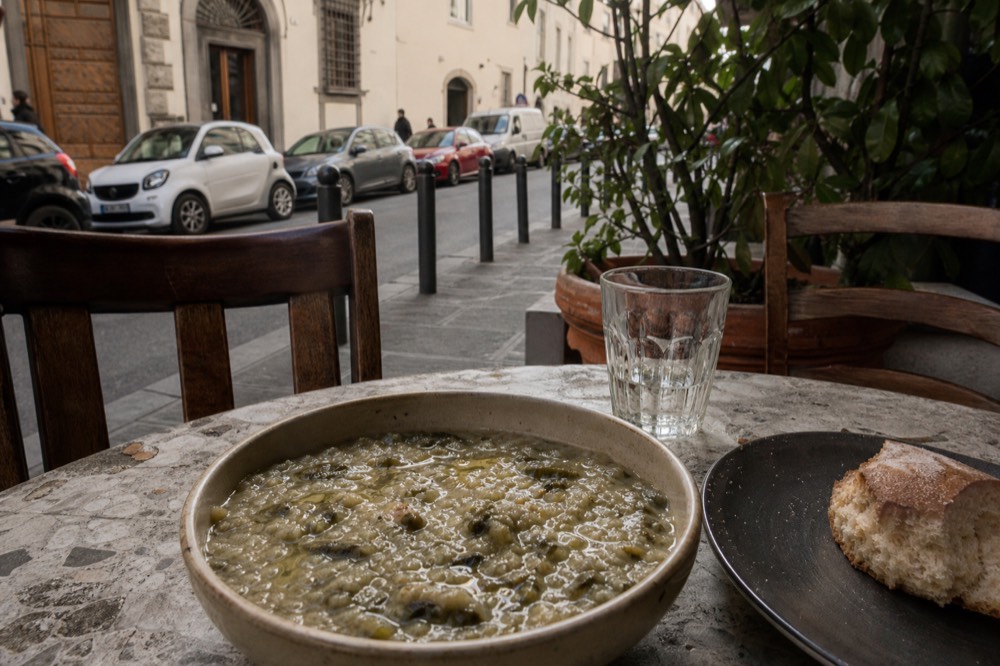
Trattoria Mario has been run by the same family since 1953, and the official line is phone reservations in the morning or an email to the restaurant, with walk-ins queued at the door. It is cash only, and it closes on Sundays and holidays. Trattoria Sergio Gozzi, a few streets away, is the purest walk-in alternative: lunch only, 12:00 to 15:00, Monday to Saturday, no reservations at all, first come first served, and its peposo, a black-pepper beef stew, is one of the best plates in the city. Arrive before 12:00 or expect a line.
Cinghiale Bianco is the evening option, and it carries the strangest booking reality in the city. Stanley Tucci named it one of his favourite restaurants in Florence in 2021 and was quoted on its ribollita, pappa al pomodoro and panzanella, and dated 2026 reviews say it is busier since the filming, with one recent review putting it plainly: book. Its own website had no working online booking when last checked, so a reader following Tucci to Borgo San Jacopo currently has no online booking route at all. Phone ahead, or take your chances at 18:00 when the door opens on weekdays, or at 12:00 on Saturday and Sunday when weekend lunch is added.
What about pasta: where do you eat pici in Florence?
The pasta dishes to order in Florence are pici, a thick hand-rolled spaghetti, pappardelle with duck ragu, and tortelli, and the rooms that do them best are Trattoria da Burde, a Bib Gourmand trattoria outside the centre where first courses cost EUR 7.50 and seconds EUR 10.50 (checked September 2026), and Osteria Vini e Vecchi Sapori near Piazza della Signoria, a ten-table room booked a month ahead by phone.
Florentine pasta is not the star of the menu, beans and meat are, but the fresh pasta tradition is real. Pici are rolled by hand into thick, irregular strands that hold a ragu better than anything machine-made, and pappardelle, wide ribbons, are the classic partner for duck or hare sauce. The rooms that still roll pasta by hand tend to be the old family trattorie, which means the same scheduling rules as everything else in this guide.
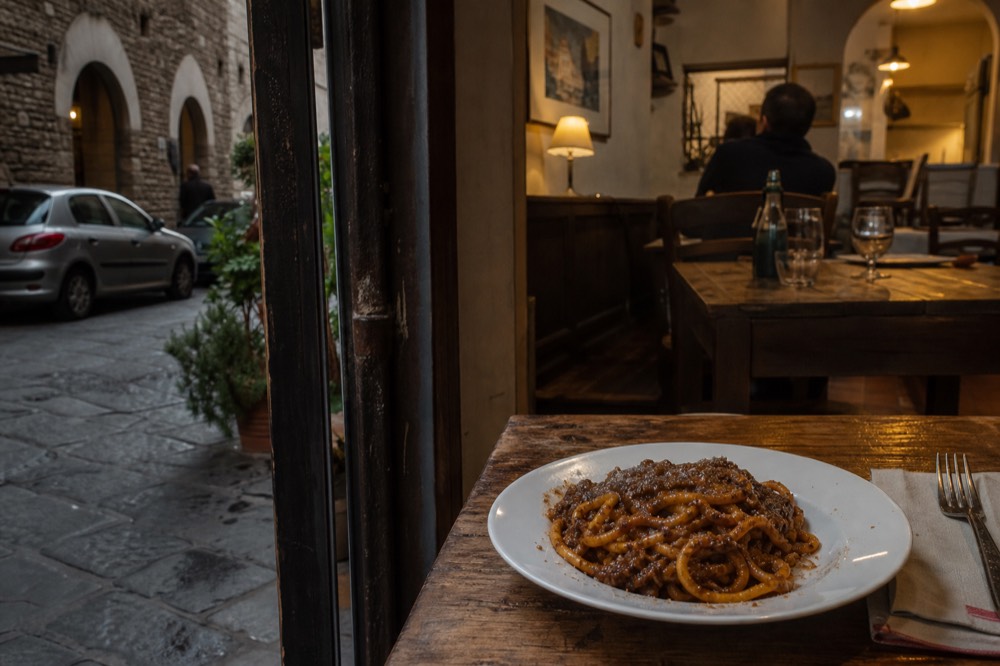
Da Burde sits out on Via Pistoiese beyond the tourist core, serves lunch daily and dinner only on Fridays, and closes on Sundays. First courses at EUR 7.50 and second courses at EUR 10.50 (checked September 2026) make it one of the best-value Bib Gourmand plates in the region, and the trip out there is the point: you eat with locals, at prices locals pay. Vini e Vecchi Sapori is the opposite problem, a room of about ten tables a minute from Piazza della Signoria that books up by phone, with one diner reporting a booking made a month ahead. Reservations are in person or by telephone only, and it turns people away constantly.
If you would rather make the pasta than eat it, the cooking class scene is the cheapest serious experience on the site: the basic pasta class with unlimited wine runs from $44 per person, rated 4.9 across 15180 reviews (checked September 2026). Our Florence cooking classes guide compares the formats, and the blog piece on what you actually cook in a Florence class answers the repertoire question honestly: fresh pasta plus a Tuscan main, because that is the regional menu.
Where do you get the best schiacciata?
The best-known schiacciata in Florence is at All'Antico Vinaio, which runs four shopfronts on via dei Neri at numbers 65, 74, 76 and 78, open every day from 10:00 to 22:00, walk-in only, with no published price for a standard schiacciata. The honest alternative is Semel by Sant'Ambrogio market, lunch-only and closed Sundays.
Schiacciata is Tuscan focaccia, flat bread dimpled with oil and salt, and at All'Antico Vinaio it is split and stuffed with anything from pecorino and truffle cream to cold cuts. The shop's own site calls it the place where it is worth queueing, and the queue reports are genuinely varied: almost an hour in line in June 2026, lines wrapped around the buildings in August 2025, and no queue at all in December 2025. One traveller in December 2025 reported the best panini with no wait at all. The lesson is season and hour: mid-afternoon in winter is a different restaurant from noon in June.
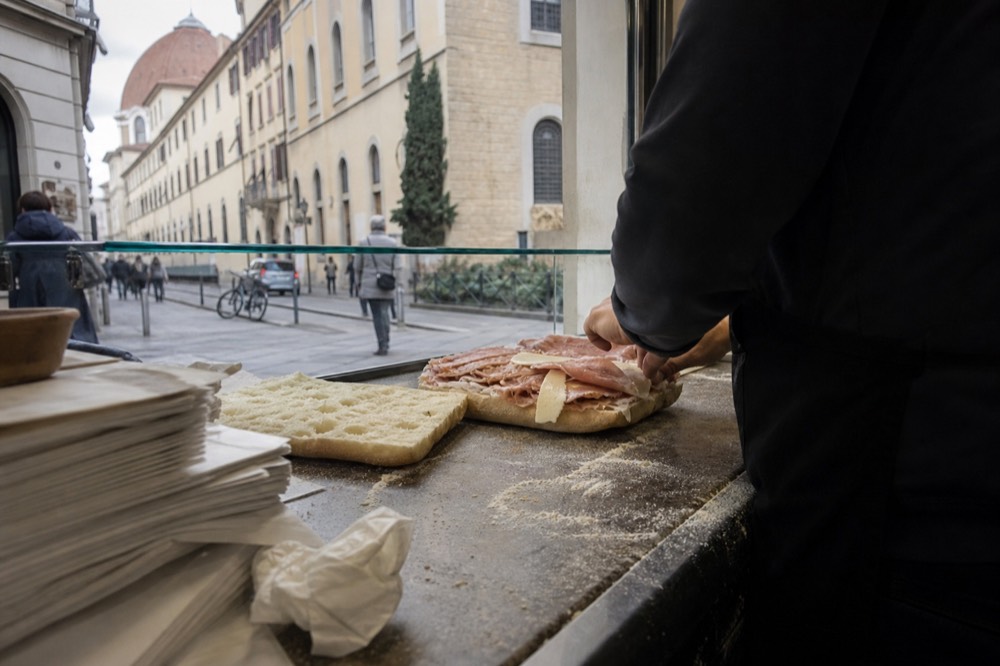
What you cannot do is skip the line, because there is no order-ahead option and the four doors share the traffic. What you can do is walk two minutes to I' Girone De' Ghiotti on Via dei Cimatori, a smaller schiacciata shop with lines that reviewers say move quickly, or cross the river to the Oltrarno counters where the queue culture barely exists. The full sandwich landscape, including the cash-versus-card question at Gusta Pizza, is covered in our street-food walkthrough of the city's counters and queues.
Which gelateria should you go to?
The gelaterias worth walking to are Gelateria della Passera in the Oltrarno, which holds Gambero Rosso's Tre Coni, the highest rating in the Italian gelato guides, Vivoli near Santa Croce, which serves cups only and closes on Mondays, and La Carraia by the bridge, open daily 11:00 to midnight with the shortest prices on the circuit.
The surprise in Florentine gelato is that the two most awarded shops in the city are not the famous queued-at ones on the tourist circuit. Gambero Rosso's Gelaterie d'Italia guide gives its Tre Coni rating to Gelateria della Passera and I Gelati del Bondi, and della Passera's Tre Coni was confirmed again in the 2027 edition reported in June 2026. Neither is on a listicle's main street. That is the single most useful gelato fact available, and almost no first page of search results has it.
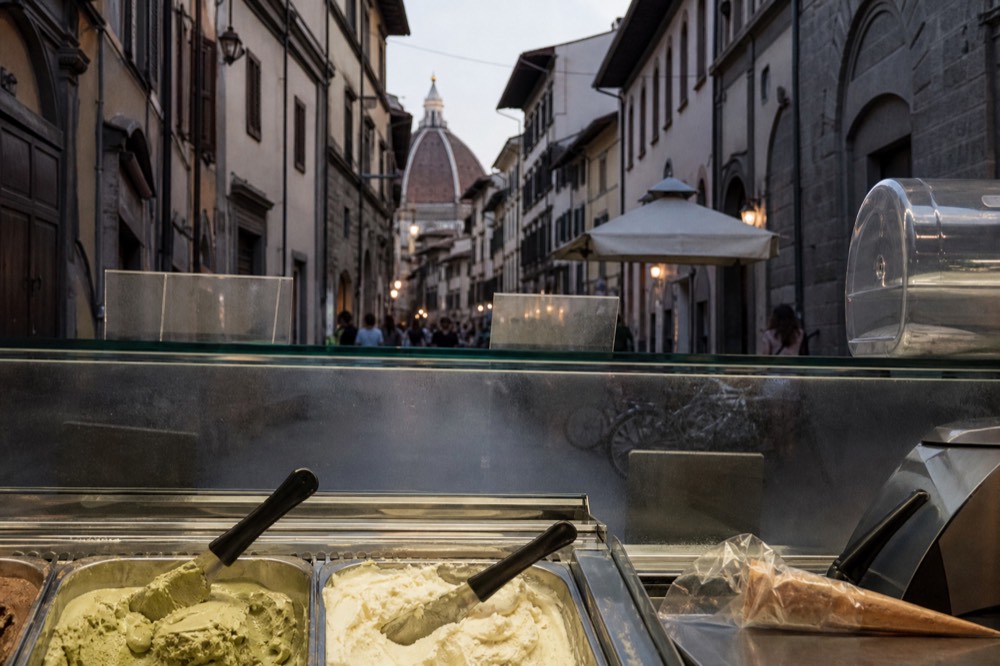
Vivoli is the famous one, and its rules are its own: cups only, never cones, because the founder believed cones detract from flavour, and closed on Mondays. Its Gran Crema al Caffè, an affogato, is the signature order. Perché No!, a short walk away and trading since 1939, is the pistachio specialist. Queues at all the famous gelaterias triple by 21:00 in summer, so the late-evening line is a real thing, but it is also the pleasantest queue in the city. Our best gelato in Florence guide ranks the shops and explains the Tre Coni system.
Can you eat all the signature dishes in one day?
You can, but only with a plan, because the four flagship dishes sit in four different closing patterns: lampredotto ends at 14:00, ribollita rooms close by 15:00 or are lunch-only, bistecca rooms open at 19:00 or 19:30, and gelato runs to midnight. The workable day is a market counter at noon, a walk-in trattoria before 15:00, a booked steak at 20:00, and gelato at 22:00.
The closing days are the trap. Trattoria Mario, Sergio Gozzi, Da Nerbone, Buca Mario and Semel all close on Sundays. Il Latini closes on Mondays, and so does Vivoli. Enoteca Pinchiorri closes Sunday and Monday. August adds another layer: family-run places commonly close for a stretch around Ferragosto, and two closures are confirmed from the restaurants' own sites, Buca dell'Orafo posting a summer closure covering most of August and Le Volpi e l'Uva posting an August closure. If your trip is in August, check each room's own site before building a day around it.
| Dish | Best window | Where | Booking reality |
|---|---|---|---|
| Lampredotto | Before 14:00, Mon-Sat | Da Nerbone, Mercato Centrale | Walk-in, queue at peak |
| Ribollita | Lunch, before 15:00 | Trattoria Mario or Sergio Gozzi | Mario: phone only, cash only; Gozzi: first come first served |
| Schiacciata | 10:00-22:00 daily | All'Antico Vinaio, via dei Neri | Walk-in, queue varies by season |
| Bistecca | From 19:00-19:30 | Sostanza, Buca Mario, Regina Bistecca | Book ahead; Sostanza is phone and cash only |
| Gelato | To midnight | Della Passera, Vivoli, La Carraia | Walk-in; Vivoli closed Monday |
One more planning fact that most visitors get backwards: the city is fullest in spring, not summer. Official figures for the first ten months of 2025 show more than 4 million arrivals and 9.7 million overnight stays, and the city's own release names April and May as the months with the most overnight stays. The small dining rooms are hardest to get into precisely when the weather is best, so spring trips need bookings made further ahead than August trips do.
The questions below are the ones visitors actually ask before a Florence trip, and each answer keeps to what the evidence supports: real prices, real closing days and real booking rules, with no invented figures. Read the ones that match your itinerary, then build your day around the clocks rather than the listicles.
Common questions about Florence Italy food
What food is Florence famous for?
Florence is famous for bistecca alla fiorentina, lampredotto, ribollita, pappa al pomodoro, pici and other fresh pastas, schiacciata, peposo, cantucci and gelato. The tradition is cucina povera: bread soups, offal, beans and cheap cuts raised to classics by generations of family kitchens.
How much does bistecca alla fiorentina cost?
Roughly EUR 40 to 60 per kilo is the normal city band, certified Chianina runs around EUR 60 to 65, and historic-centre rooms can exceed EUR 80 per kilo (checked September 2026). One steak weighs about 0.9 to 1.2kg and feeds two people.
What time do Florentines eat dinner?
Dinner service generally starts between 19:30 and 20:00, and Florentines eat around 20:00 to 21:00. A good trattoria is not full until after 20:15, so a 20:00 booking is the local hour, not the tourist one.
Do you need reservations for restaurants in Florence?
For the famous small rooms, yes. Trattoria Sostanza takes phone bookings only and is cash only, Osteria Vini e Vecchi Sapori books up weeks ahead by phone, and Cinghiale Bianco's own site was unresponsive when checked, so phone ahead. Counters and sandwich shops are walk-in only.
What can you eat in Florence without a reservation?
Plenty: Da Nerbone for lampredotto, All'Antico Vinaio for schiacciata, Trattoria Sergio Gozzi for lunch if you arrive before noon, Semel for sandwiches, and every gelateria on this page. The no-reservation city is the lunch-and-counter city.
Is Florence food expensive?
It does not have to be. A lampredotto panino at Da Nerbone costs EUR 5 (checked September 2026), a full lunch at Da Burde runs EUR 7.50 for a first course and EUR 10.50 for a second (checked September 2026), and a per-person coperto charge is added on top. Steak is the one dish that adds up fast, because it is priced by weight.
Choose Your Florence Food Experience
Initial editorial recommendation
Full Tuscan Meal Walk
Eat the equivalent of a full meal across at least four stops, with a local guide explaining the dishes. Check your travel date before arranging your other meals.
3.5 hours, English and Italian. Food, water and at least one alcoholic drink for adults included; gratuities excluded.
Compare The Formats And Adjust Your Choice
Plan the dishes around opening hours. A tasting walk covers its own listed foods; classes offer a separate way to learn the recipes.
Florence Food Tastings Walk: Try lampredotto and other Tuscan specialties with a local guide, choosing the San Lorenzo or Sant'Ambrogio route. 3 hours, English guide. Menus and meeting points depend on the route; contact the operator about dietary needs. Tips and private transport excluded.
Evening Steak And Wine Walk: Combine a walk through Florence with a sit-down Florentine steak dinner and other tastings. 3.5 hours, English guide. Hotel transfers and optional tips excluded. Walking required; dietary needs need advance confirmation.
Pasta Or Lasagna Cooking Class: Make fresh pasta, or choose the longer market, lasagna and tiramisu option; then eat what you prepared. Pasta option: 3 hours. Market, lasagna and tiramisu: 5 hours. English instruction, meal and equipment included. Market closed Sundays; not suitable for coeliac guests.
No verified recommendation meets these choices. Adjust the time or experience, or reset. For dietary, age or access requirements, obtain the operator's confirmation before booking.
Choose a date to see Viator's scheduled departures. Availability and final price are confirmed on Viator.