How to eat cheaply in Florence?
Sourced tactics for eating well in Florence without overspending: market counters, no-reservation trattorie, wine windows, and the one or two paid experiences that are genuinely cheaper than a restaurant meal.
 By Giulia Conti, Florence Food Tour Specialist and Culinary Guide
How to eat cheaply in Florence?
Yes, and the answer is structural, not a list of discounts: eat where the market system sets the price, eat the dishes Florentines themselves eat at lunch, shift your main meal to midday, and treat dinner as the cheap second act of the day. Florence is not an expensive city to eat in if you follow the locals' own cost hierarchy: market counters first, working trattorie second, tourist-route restaurants a distant last. The tactics below are all sourced from the venues' own sites and dated reports, not from a price survey that will be stale by the time you read it.
The single biggest saving has nothing to do with which restaurant you pick. It is the clock. Florentines eat dinner around 20:00 to 21:00, and a good trattoria is not full until after 20:15, while tourist-facing places in the centre open around 19:00. Turn up at 18:30 out of hunger and you will eat at whichever place on the tourist route has already opened, which is exactly the wrong filter for both quality and price. Our piece on Florence dinner times and local eating hours covers the mechanics in detail.
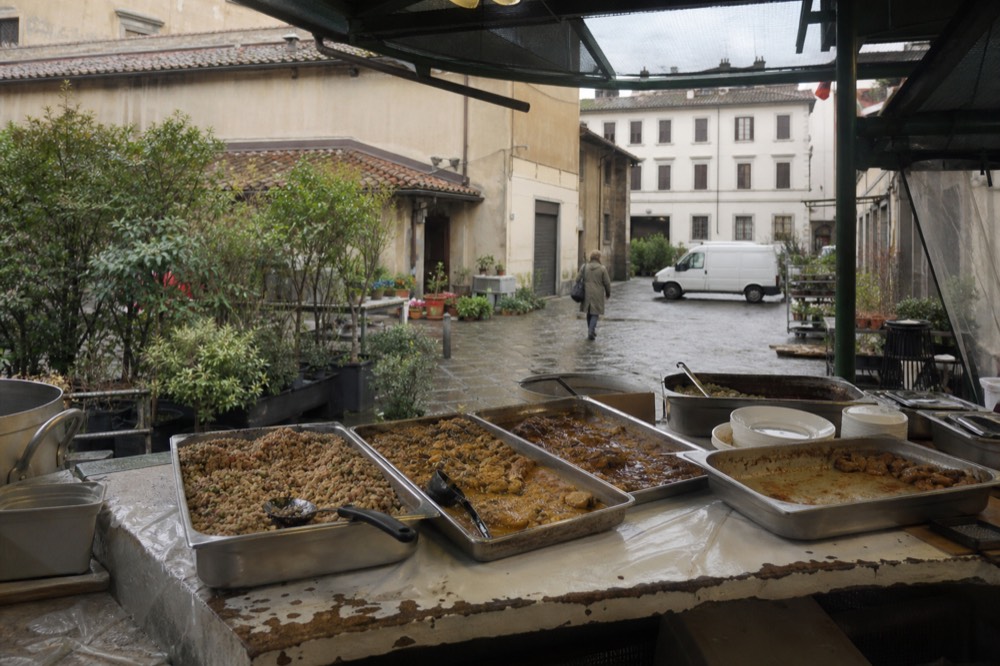
The second biggest saving is choosing the no-reservation, lunch-only trattorie. These places are cheap because they run one sitting, turn tables fast, and cook a fixed daily repertoire. Trattoria Sergio Gozzi near San Lorenzo is lunch only, 12:00 to 15:00, Monday to Saturday, first come first served, with reported waits of up to 45 minutes if you arrive late. Trattoria Mario, a few streets away, is the same model: cash only, no reservations, lunch only, and guides advise arriving at 11:45 to queue before the noon opening. Neither publishes prices, but both are market-driven working kitchens, and the 2026 guides that cover them place them firmly in the budget band.
Where do the cheapest meals in Florence actually come from?
From five sources, in order of value: the historic markets' cooked-food counters, the lunch-only no-reservation trattorie, the sandwich shops on via dei Neri and around Sant'Ambrogio, the aperitivo hour, and the wine bars that price by the glass rather than by the setting. Everything else in the centre is paying for a room, a view or a queue, and you can have all three cheaply elsewhere if you know where. The market system is the backbone of all of it.
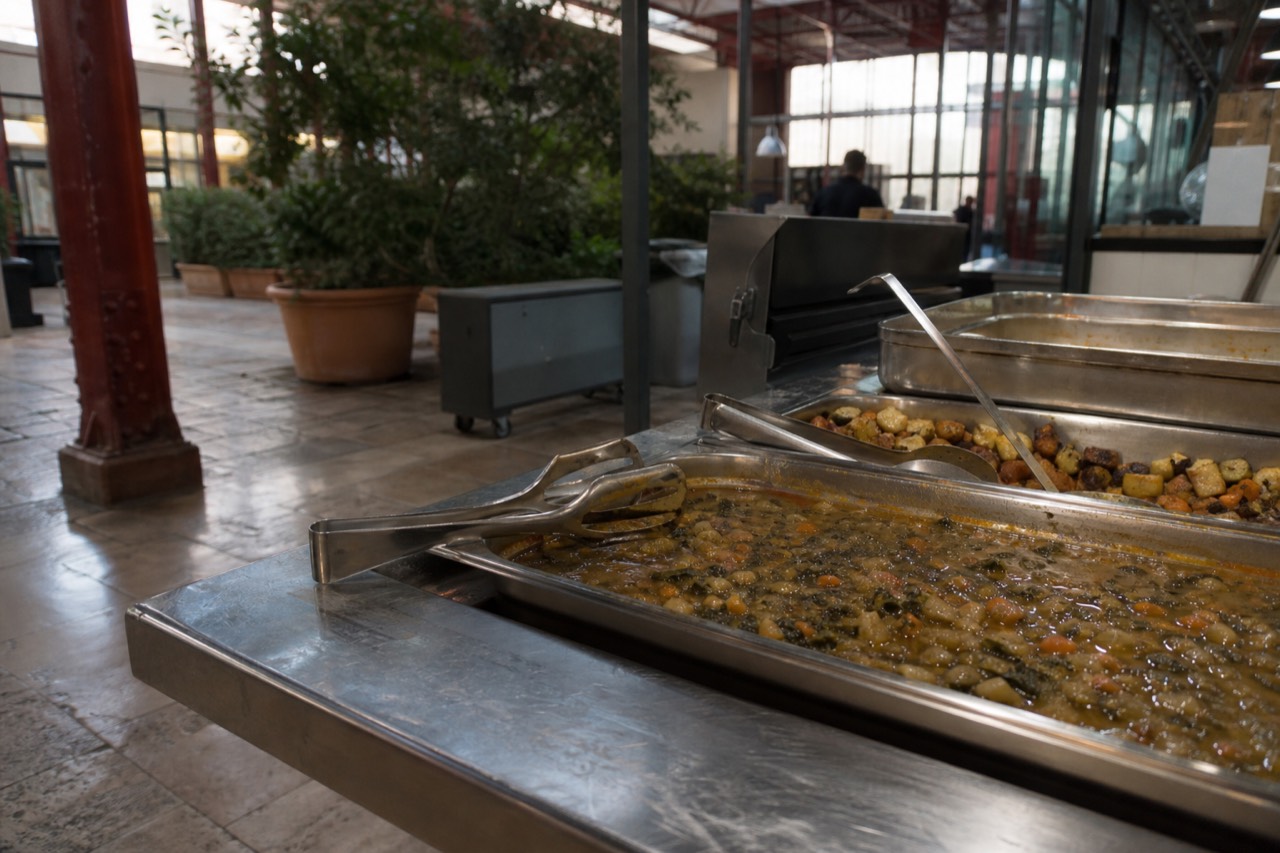
Start with Mercato Centrale in San Lorenzo, which is really two operations in one building. The first-floor food hall is open every day 09:00 to 23:00 (checked September 2026), while the ground-floor historic market, the fruit, vegetable, meat and fish traders, runs Monday to Friday 07:00 to 15:00 and Saturday 07:00 to 17:00, closed Sunday. The ground floor is where the cheap eating happens, because that is where Da Nerbone has sold its lampredotto and boiled-meat panini from the same spot since 1872: a lampredotto panino at €5 and a panino col bollito at €6 (checked September 2026). Our guide to Mercato Centrale and Florence's food markets maps the whole building.
Sant'Ambrogio, the market Florentines actually shop at, works the same way. Da Rocco inside the market runs a daily menu in the €8 to €12 range, lunch only, roughly 11:30 to 14:30, closed Sunday, no reservations, and the standing advice is to arrive by 13:00 or forget it. Semel, on the square outside, sells inventive daily panini from 11:30 to 14:30, closed Sundays, with almost nowhere to sit. Both are in the same price universe as Da Nerbone, and both are cheaper than any sit-down meal within ten minutes' walk of the Duomo.
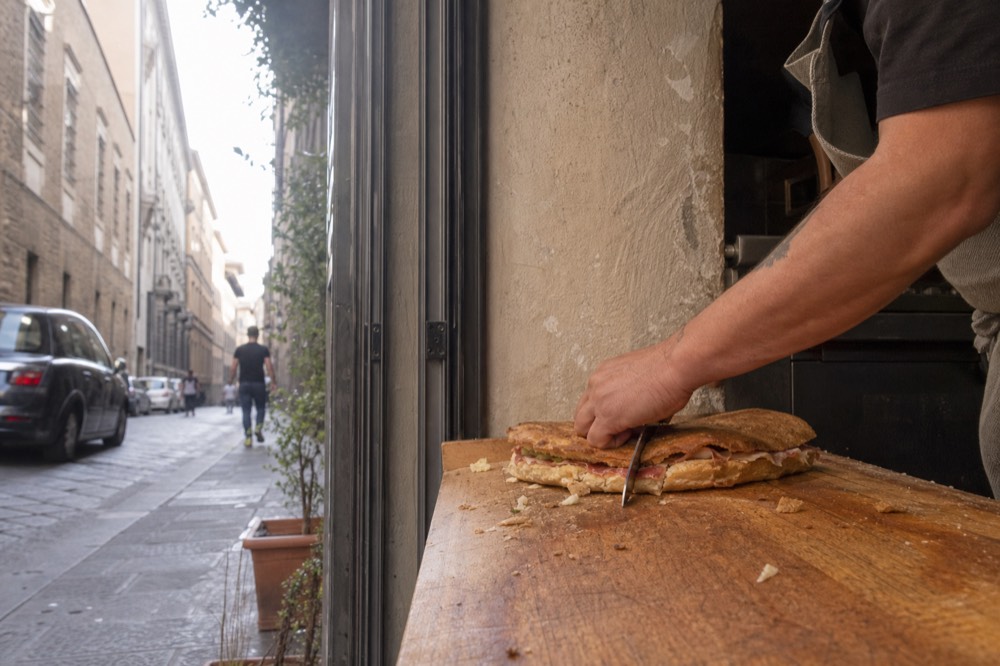
The sandwich route needs one honest caveat. All'Antico Vinaio on via dei Neri calls itself, in its own words, the place where it is worth queuing, and it does not publish prices on its own site, so we cannot tell you what a schiacciata costs there. What we can tell you is that dated traveller reports range from almost an hour in line in June 2026 to no queue at all in December 2025, and that it is open daily 10:00 to 22:00 across four shopfronts at 65, 74, 76 and 78 via dei Neri (checked September 2026). If the line is long, the same street and the streets around it have other panino shops with no queue at all, and the Reddit threads on the subject say exactly that.
A table of the sourced cheap routes, with what each one costs and when it works:
| Cheap route | What you pay (checked September 2026) | When it works | Catch |
|---|---|---|---|
| Da Nerbone, Mercato Centrale ground floor | Lampredotto panino €5, bollito panino €6 | Mon to Sat, roughly 09:00 to 14:00 | Closed Sunday; queues at the 12:30 to 14:00 peak |
| Da Rocco, inside Sant'Ambrogio market | Daily menu €8 to €12, per florencetourism.org | Lunch only, about 11:30 to 14:30, closed Sunday | Arrive by 13:00 or the tables are gone |
| Trattoria Sergio Gozzi, San Lorenzo | Budget working-trattoria band, prices not published | Lunch only, 12:00 to 15:00, Mon to Sat | No reservations; waits reported up to 45 minutes |
| Trattoria Mario, San Lorenzo | Budget band, prices not published | Lunch only, Mon to Sat, queue from 11:45 | Cash only, no reservations |
| Semel, Piazza Ghiberti | Panino prices not published | 11:30 to 14:30, closed Sunday | Almost nowhere to sit |
| Gusta Pizza, Oltrarno | Pizza prices not published | Tue to Sun, about 11:30 to 23:30 | No reservations, closed Monday, 10 to 20 minute waits reported in 2026 |
If you would rather have someone else handle the logistics, the same walk can be booked directly, and free cancellation means you can lock in a spring date now and adjust when your plans settle.
Can you sit down for a full trattoria meal and still spend little?
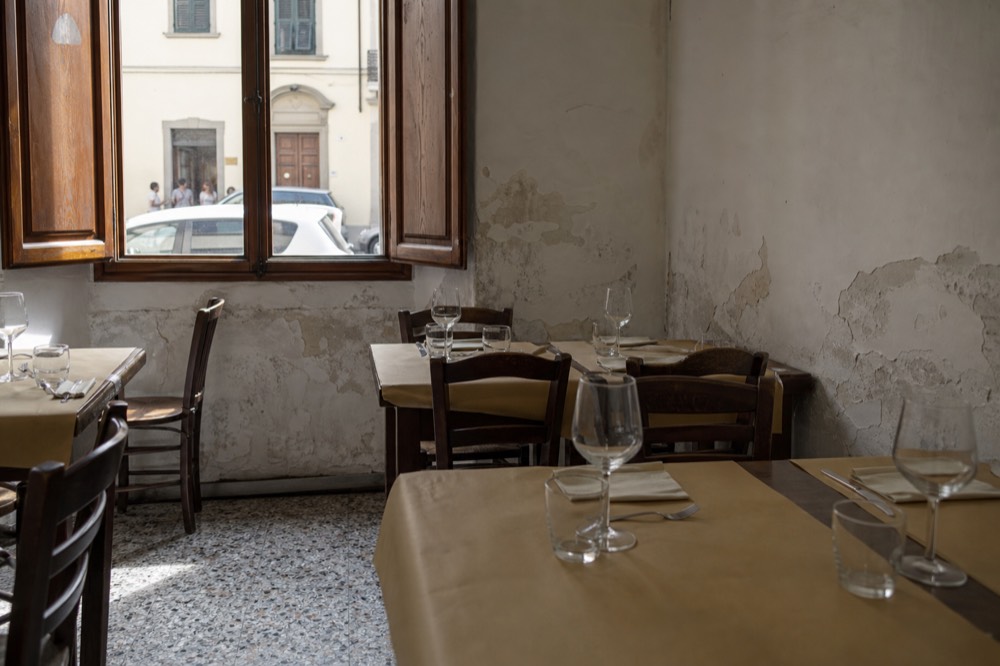
Yes, you can, provided you go at lunch to a no-reservation neighbourhood trattoria and accept the two conditions that keep their prices low: a single sitting and a fixed daily repertoire of dishes. Choose one of these old-school spots, order the set menu or the dish of the day, and a full meal with wine can still cost very little. Trattoria Sabatino in San Frediano is the clearest example: no reservations, a daily menu reported at around €12, and the standing advice is to arrive 30 minutes before opening to get a table in the first sitting. It closes at weekends, which tells you who it cooks for. This is the working end of Florentine dining, and it is the cheapest hot plated food in the city, full stop.
The pattern repeats across the Oltrarno. Trattoria 4 Leoni is reported in the €20 to €40 per person band, which is not budget territory but shows the gradient: the further you walk from Ponte Vecchio, the further the same money goes. Il Santo Bevitore in Santo Spirito is a mid-range trattoria where lunch is realistically walk-in while weekend dinners need a booking, so the same room is cheap at noon and contested at night. The rule of thumb is blunt: cross the river, eat at lunch, and the price of a full Tuscan meal drops by half.
Two cautions keep the savings real. First, the coperto: the per-person cover charge is legal in Tuscany, typically about €1 to €3 per person across Italy and up to around €5 at smarter places, and it must be shown on the menu before you order, so read the menu's footnotes rather than just the pasta prices. Second, the servizio line: where a bill already includes a service charge of roughly 10 to 15 percent, no further tip is expected, and Italians otherwise leave nothing or round up a euro or two in cash. Our page on the coperto and what it covers explains the mechanics, and the short version is that a sit-down meal carries two small fixed costs a counter panino does not.
What about wine and gelato without overspending?
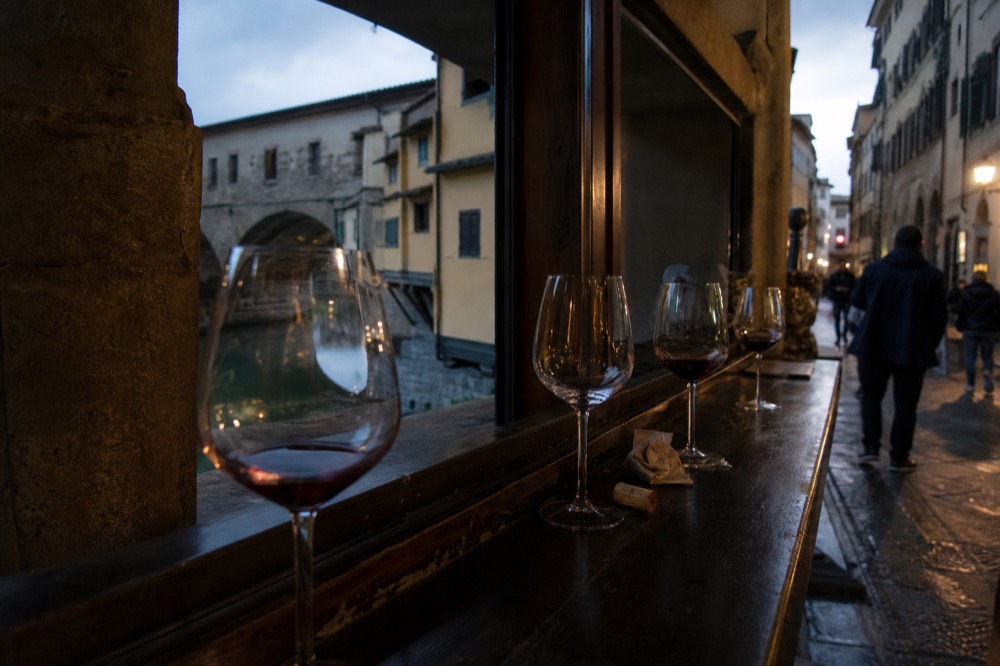
Wine is the cheapest thing in Florence to drink well, if you buy it standing up: the wine windows and the standing enoteche price by the glass, and the wine-bar staples run €10 to €20 per person for a glass and a tagliere of cheese and salumi. Le Volpi e l'Uva near Santo Spirito is the archetype, a standing wine bar where a glass and a tasting board lands in the €10 to €20 band, with limited phone reservations for its few outside tables and a queue that often forms by 19:30. Casa del Vino in San Lorenzo does the same thing at lunch, panini and wine, no reservations, closed at weekends.
The wine-window route adds history for free. The association that catalogues them counts 164 surviving buchette inside the old city walls, and only 15 public venues have restored one and will actually pass something through it, a split that surprises most visitors who assume every window in town still serves. Babae in Santo Spirito is the best known of them. One structured option: the wine-tasting experience in front of Ponte Vecchio, about an hour, rated 4.6 across 71 reviews, from $46 (checked September 2026), which is less than two glasses plus a cover charge at a river-view restaurant.
Gelato is the one category where the cheapest option is rarely the best, but the good options are still cheap. The two Florence gelaterie holding Gambero Rosso's Tre Coni, the highest rating in the Italian gelato guides, are Gelateria della Passera and I Gelati del Bondi, and neither is on the famous tourist circuit. The famous ones, Vivoli and La Carraia, have their own virtues and their own queues: La Carraia is the value play of the central gelaterie, with lines that move fast, while Vivoli serves cups only, no cones, and closes Mondays. None of these will break a budget; the mistake to avoid is the gelateria with the towering whipped mounds in the window, which is a sign of industrial product, not artisanal.
Is a cooking class or food tour ever the cheap option?
Occasionally, yes, and the arithmetic is simple: a three-hour pasta class with unlimited wine starts from $44 per person (checked September 2026), which is less than many sit-down dinners for two in the centre, and you eat what you cook. The Florence cooking-class market is large and competitive, which keeps the entry price down, and the cheapest class on the site, the pasta class rated 4.9 across 15,180 reviews (checked September 2026), carries a "Likely to sell out" badge on its listing because the cheap sessions go first. At that price the class is not a splurge, it is a meal with a lesson attached.
One timing note that saves both money and disappointment: the city's own figures put April and May as the months with the most overnight stays, more than 4 million arrivals in the first ten months of 2025, so the cheap formats and the cheap trattorie are under the most pressure in spring, not in August. Book the paid things ahead in April, and in August check the individual closure, since family-run places commonly close for a stretch around mid-month; Buca dell'Orafo, for instance, posts its own summer closure covering most of August on its site. The site that pulls all of this together, Best Restaurants in Florence, tracks the individual venues so you do not have to.
Whether you build the day yourself from the market counters or let a guide walk you through them, these are the three cheapest structured ways to eat Florence:
The short answers: market counters and lunch-only trattorie for the cheapest hot food, standing wine bars for the cheapest good drink, and a $44 cooking class or a $63 street-food walk when you want the structure handled for you. (checked September 2026) Prices matter less than queue mechanics here, so it pays to know how the lines actually work before you go as much as the prices, because the cheapest places in Florence trade money for time.
Common questions about eating cheaply in Florence
How to eat cheaply in Florence?
Eat at the market counters, Da Nerbone at Mercato Centrale and Da Rocco at Sant'Ambrogio, eat your main meal at lunch in the no-reservation trattorie like Sergio Gozzi and Sabatino, drink wine standing at an enoteca rather than sitting at a restaurant, and shift dinner late, after 20:00, when the tourist-priced early sittings are over.
How much is a lampredotto panino in Florence?
At Da Nerbone in Mercato Centrale, the historic stall that has sold from the same spot since 1872, a lampredotto panino is €5 and a boiled-meat panino is €6 (checked September 2026). It is open Monday to Saturday, roughly 09:00 to 14:00, closed Sunday.
Is Mercato Centrale expensive?
The two floors are different economies. The ground-floor historic market is the cheap one, with the traders and Da Nerbone running roughly 07:00 to 15:00 on weekdays and closing on Sundays. The first-floor food hall is open every day 09:00 to 23:00 and prices like a food court, convenient but less cheap.
Do you need reservations at the cheap trattorie?
No, and most of them do not take them. Sergio Gozzi, Mario, Sabatino, Semel and Da Rocco are all first come first served, which is part of why they stay cheap. The cost is your time in a queue, and the fix is arriving before the noon opening or before the 13:00 peak.
Is a food tour worth it if you are on a budget?
The street-food walking formats start at $63 and include tastings, so part of the ticket replaces food you would have bought anyway (checked September 2026). A pasta cooking class with unlimited wine starts from $44, less than many restaurant dinners, and you eat the results. Both are cheaper than a bad meal on the tourist route.
What is the coperto and does it make eating out expensive?
The coperto is a per-person cover charge, legal in Tuscany and typically about €1 to €3 across Italy, up to around €5 in smarter places, shown on the menu before you order. It adds a couple of euros to a sit-down meal but nothing to a counter panino or a standing glass of wine, which is one more reason the cheap routes are cheap.
Choose Your Florence Food Experience
Initial editorial recommendation
Pasta Or Lasagna Cooking Class
Make fresh pasta, or choose the longer market, lasagna and tiramisu option; then eat what you prepared. Check your travel date before arranging your other meals.
Pasta option: 3 hours. Market, lasagna and tiramisu: 5 hours. English instruction, meal and equipment included. Market closed Sundays; not suitable for coeliac guests.
Compare The Formats And Adjust Your Choice
Market counters remain the budget answer. Pay for a class or guide when the extra skill or context matters, using your own totals to compare.
Full Tuscan Meal Walk: Eat the equivalent of a full meal across at least four stops, with a local guide explaining the dishes. 3.5 hours, English and Italian. Food, water and at least one alcoholic drink for adults included; gratuities excluded.
Private Coffee And Sweets Walk: Discover coffee, pastries and artisan chocolate, ending with gelato or affogato. 2 hours, English available. All tastings included; hotel pickup excluded. This is a tasting walk, not a Vivoli reservation.
No verified recommendation meets these choices. Adjust the time or experience, or reset. For dietary, age or access requirements, obtain the operator's confirmation before booking.
Choose a date to see Viator's scheduled departures. Availability and final price are confirmed on Viator.