How to avoid tourist traps when eating in Florence?
The honest tells that separate Florence's real trattorie from the tourist mills: timing, menu, price and location checks, plus what to make of the famous queued places.
 By Giulia Conti, Florence Food Tour Specialist and Culinary Guide
How to avoid tourist traps when eating in Florence?
The single most reliable tell is the clock: a dining room that is full at 18:30 in Florence is a room full of tourists, because dinner service generally starts between 19:30 and 20:00 and locals eat later still, around 20:00 to 21:00. Add menu, price and location checks and most traps filter themselves out.
That timing fact is the backbone of everything else on this page, and it is worth dwelling on. A restaurant that is heaving before 19:00 is not necessarily bad, but it is serving an audience that eats at tourist hours, and kitchens calibrate to their audience. The food gets simpler, the portions get bigger, the prices get rounder. A visitor who walks the centre at 18:30 and picks the one place already open has applied exactly the wrong filter without realising it.
The second tell is the menu itself. Photo menus of food, laminated cards in four languages, a host standing on the pavement inviting you in: none of these is a guarantee of a bad meal, but all three together are a strong hint that the restaurant does not need repeat business. Florentines rarely eat at places with a tout on the door, because in a city this size a restaurant that is good does not have to ask.
The third tell is where the money goes. The coperto, the per-person cover charge, is legal across Italy and normal in Florence, but it must be printed on the menu or price list before you order. A menu with no prices at all, or a cover charge that appears only on the bill, is a different animal from a trattoria charging a printed two or three euros per head.
There is a version of this trip where you never roll the dice at all: a guided tasting walk puts you in front of market stalls, wine counters and small kitchens that a first-time visitor would walk past. The selection below covers three honest ways to do that, from a small-group Tuscan flavours walk to a market feast and a private ten-tastings route.
If a guided walk is not your style, the tells on the rest of this page work on their own. The site behind this article, Best Restaurants in Florence, exists because the city's honest places are findable with a small number of checks, and because the tourist mills are concentrated enough to be avoided by pattern rather than by luck.
What time do Florentines actually eat dinner?
Dinner service in Florence generally begins between 19:30 and 20:00, and Florentines themselves eat around 20:00 to 21:00, so a good trattoria is not full until after 20:15. Tourist-facing places in the centre open earlier, around 19:00. Eat at 18:30 and you have selected for the tourist route by accident.
This is the most reusable fact on this site, and it is sourced rather than folkloric. A dated local guide puts it plainly: Florentines eat at 8, sometimes 8:30, often 9, and a good trattoria will not even seat a full house until 8:15. The practical translation is that the emptiness of a dining room at 19:15 tells you nothing bad. In fact it is mildly good news: you have found a place that opens when Florentines eat.
The inverse is the trap detector. A room full of diners at 18:30, in a city where kitchens barely light the stove before 19:30, is a room calibrated entirely to visitors. Some of those places are decent. Many are not. Either way, you are not eating Florentine food in a Florentine rhythm, and the rhythm is half of what you came for.
Lunch follows the same logic in reverse. The traditional market downstairs at Mercato Centrale runs Monday to Friday 07:00 to 15:00 and Saturday 07:00 to 17:00, closed Sunday, while the food hall upstairs is open every day 09:00 to 23:00 (checked September 2026). A Sunday-afternoon visitor finds only the food hall. Knowing which operation you are standing in is itself a small act of trap avoidance, because the two floors sell very different experiences at very different prices.
The same timing logic explains why the no-reservation trattorie are worth the queue. Trattoria Sergio Gozzi serves lunch only, 12:00 to 15:00, Monday to Saturday, first come first served, and Trattoria Mario near the market is cash only and walk-in at lunch. These places cannot be a tourist trap in the classic sense, because a trap needs to convert a one-time customer, and a queue of regulars is the opposite business model.
Should you book a food tour instead of gambling on dinner?
A guided walk is the one way to eat in Florence where the filtering has already been done for you, and the cancellation terms are usually forgiving, so a change of plans costs nothing.
Which streets and menu tells should make you walk on?
Be suspicious of: photo menus, a host inviting you in from the pavement, prices only in dollars or rounded to the euro five, bistecca priced per steak rather than per kilo, and any menu with no prices at all. In Florence these cluster on the highest-footfall streets between the Duomo, the Uffizi and Ponte Vecchio, where rent selects for volume over cooking.
Geography does some of the work here, but not crudely. Via dei Neri, the sandwich street par excellence, is high footfall and also home to All'Antico Vinaio, whose own site calls itself the place where it is worth queueing, with four shopfronts at 65, 74, 76 and 78, open daily 10:00 to 22:00 (checked September 2026). The street is not the trap; the business model is. A sandwich shop with a fast-moving queue and a chalkboard menu is not the same animal as a restaurant with a laminated photo card and a tout.
The menu tells are more reliable than the street. A real Florentine menu is short, seasonal and priced per dish, with the bistecca alla fiorentina priced per kilo because it is a single large cut, traditionally cut three to four fingers thick, roughly 5 to 6cm, and typically weighing between about 0.9kg and 1.2kg. A menu that offers a "Florentine steak for two" at one flat price is not lying to you, but it is simplifying the dish into a product, and the kitchen will treat it that way.
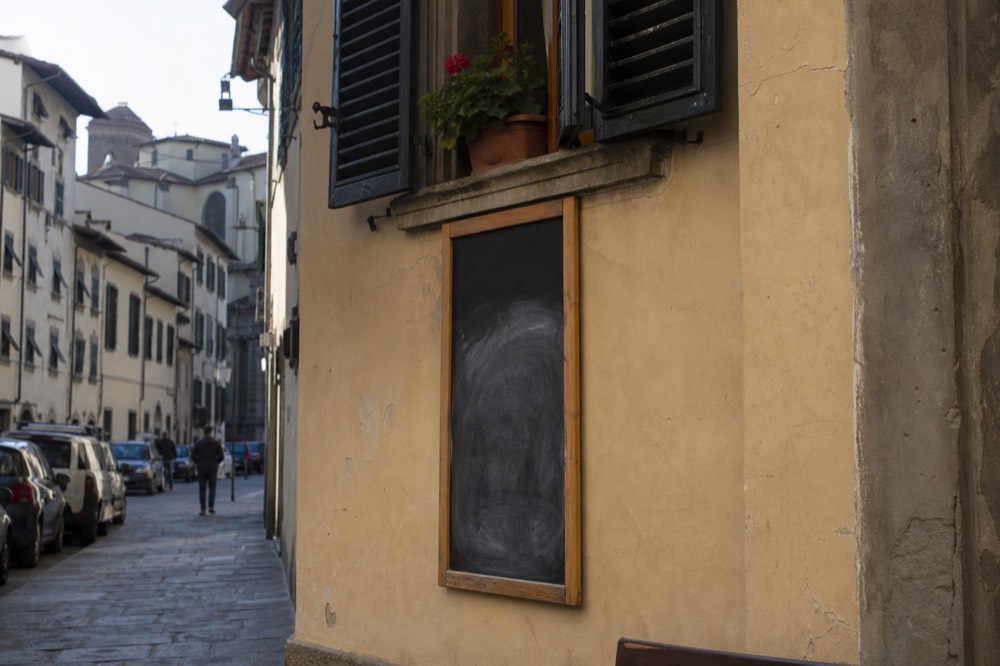
The bill tells are the last filter. The coperto is legal in Tuscany, unlike Lazio where a regional law banned it in 2006, and the national band runs about EUR 1 to 3 per person, up to about EUR 5 in smarter places, with heavy tourist areas able to climb higher. It must be shown on the menu before you order. A place that hides it is telling you something. Our full page on what the coperto charge means breaks the law and the amounts down.
One more structural fact worth knowing, because it explains why the centre feels the way it does: Florence's Regolamento Unesco restricts new food-service and takeaway outlets in the historic centre, and the city council extended it for five more years, to 2031, in April 2026. The rule has survived court challenges. In practice this freezes the existing stock of eating places, which means the good ones cannot multiply and the mediocre ones cannot be competed away. The trap density you feel is partly a regulated equilibrium, not just market failure.
How do you read a bill like a local?
Check three lines: the coperto, printed on the menu before you order; the servizio, a service charge of roughly 10 to 15 percent that sometimes appears on tourist-facing bills; and the bistecca, which must be weighed and priced per kilo. Where a servizio appears, no further tip is expected, and Italians otherwise leave nothing, round up, or give a euro or two in cash.
Tipping anxiety is itself a small tourist-trap tax, because visitors who are unsure of the norms overtip everywhere and kitchens know it. The honest position is that tipping in Florence is optional and not expected at United States levels. Where service is already covered by the coperto or a servizio line, adding more is a choice, not a duty.
The bistecca line deserves its own attention, because it is where the largest and least visible markup lives. The normal band in Florence runs roughly EUR 40 to 60 per kilo, with certified Chianina around EUR 60 to 65, and historic-centre rooms comfortably above EUR 80 per kilo (checked September 2026). One dated menu listing for Trattoria Za Za, the highest-volume name on the tourist circuit, shows the costata at EUR 46 per kilo and the filetto at EUR 52, figures from a secondary menu aggregator rather than the restaurant's own site. If a menu shows no per-kilo price for the steak, ask before ordering, not after.
| Tell | What a real place does | What a trap does |
|---|---|---|
| Clock | Empty at 19:00, filling after 20:15 | Full at 18:30 |
| Menu | Short, seasonal, chalkboard or printed, priced per dish | Photo menu, four languages, laminated |
| Steak | Priced per kilo, weighed | Flat "steak for two" price |
| Coperto | Printed on the menu, usually EUR 1-3 per head across Italy, up to about EUR 5 at smarter places | Appears only on the bill |
| Door | No host outside | A tout inviting you in |
| Location | One address, one kitchen | Multiple near-identical menus on one street |
None of these six tells is a verdict on its own. All'Antico Vinaio ticks the "queue outside" and "high footfall street" boxes and is emphatically not a trap in the way that matters, because the product is real and the queue moves. The tells are a stack: the more of them a place ticks, the faster you should walk.
What about the famous places everyone queues for?
Queues are not proof of a trap. Trattoria Za Za runs two lines, one for reservations and one without, and its own site currently says online booking is suspended and to call 055 21 54 11. Gusta Pizza states in both languages that it does not accept reservations. All'Antico Vinaio has four doors on one street and dated reports of waits from none to almost an hour. Judge the product, not the line.
Gusta Pizza is the cleaner case. The pizzeria states it plainly on its own channels: "Non si accettano prenotazioni. We do not accept reservations", and on Instagram, "Just a reminder that we do NOT accept reservations through any platform". Dated 2026 reports describe waits of ten and twenty minutes, and one Thursday at 21:00 was "not bad at all". A no-reservation policy with a moving queue is the opposite of a trap's economics: it is a place refusing to convert foot traffic into pre-committed covers.
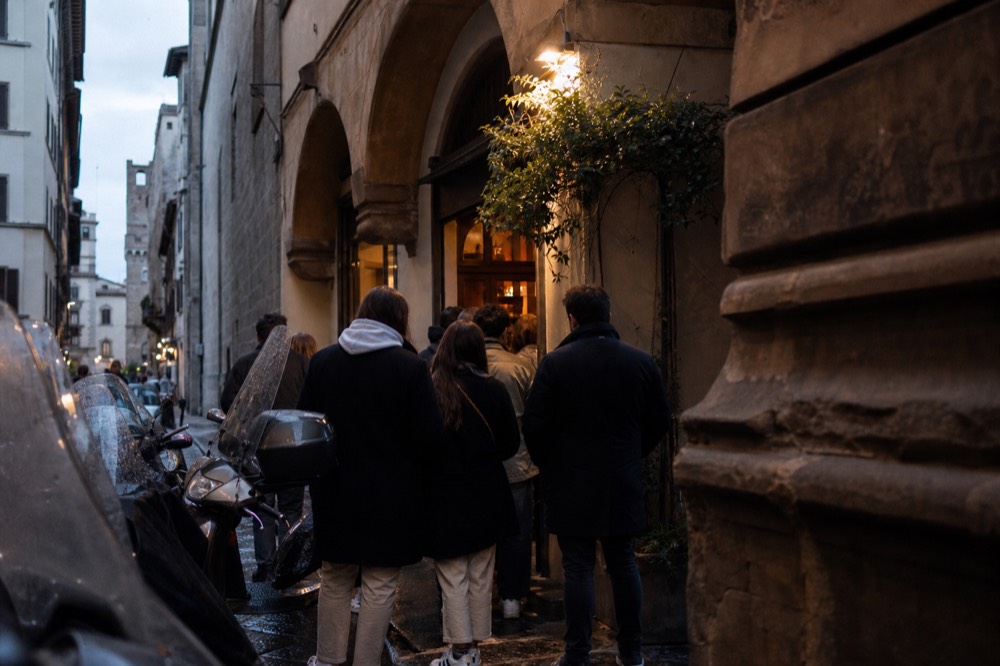
The useful distinction is between fame and capture. A famous place earns its queue with a product you cannot easily get elsewhere, and you can decide in thirty seconds of watching whether the line moves and what people walk out carrying. A trap converts you before you can watch, with a host, a photo menu and a table available immediately at 18:30 in a city that eats at 20:30. For more on the honest side of the ledger, our guide to where locals actually eat in Florence names the rooms that run on regulars.
There is also a middle path: eat the city with someone whose job is knowing the difference. A small-group walk through Sant'Ambrogio market, capped and led by a local, puts you at counters a first-time visitor would not recognise, and the market setting is itself one of the tells above working in your favour.
The same logic extends to the evening. A food tour that ends with a Florentine steak and Tuscan wine in a small group is not a trap by construction, because the operator has chosen the kitchen and staked its reputation on the choice.
Do food tours count as tourist traps?
A food tour is a trap only when it sells the idea of authenticity without the substance: huge groups, chain-affiliated stops, tastings you could buy cheaper at the counter. The honest versions are small-capped, name their stops or their neighbourhood, and cost roughly USD 60 to 130 per person for a walking format. Judge them by group size and cap, not by price alone.
The roster of Florence food experiences tells the story through its caps. One full Tuscan meal tour and a VIP steak dinner tour both run as small-group experiences, a masterclass in Florentine steak runs as a small group, and a gelato class caps at 6. Those caps exist because the kitchens and counters involved are small, and a cap is the single clearest signal that an operator is fitting the group to the place rather than the place to the group.
Price is a weaker signal than visitors assume. The cheapest real experience on this site is a pasta cooking class from USD 44 per person, and the cheapest walking format is a street-food walk from USD 63 (checked September 2026), while a private ten-tastings tour runs from USD 134. The spread is format, not quality: a class with unlimited wine and a guided walk through six kitchens are different products, and both can be honest.
The spring peak matters more than visitors expect. If you are coming in April or May, the rooms are at their fullest precisely when the weather is at its best, and the no-reservation places are the ones where the queue is longest. Book the bookable ones, and for the rest, our page on whether you need reservations in Florence sorts the city's rooms by how they take a table.
Put together, the tells and the tour formats point to the same conclusion: Florence rewards visitors who eat on the city's clock and in small rooms, whether you find those rooms yourself or follow a guide who has already done the filtering. The three walks below are the formats we would hand to a friend who wanted the honest version of the city without doing the research.
The short answers below cover the clock, the queue, the bill and the tour question in one place. The core method is unchanged: eat at Florentine hours, read the menu for per-kilo pricing and a printed coperto, distrust a host on the door, and treat a moving queue as a good sign rather than a bad one.
Common questions about avoiding tourist traps in Florence
How to avoid tourist traps when eating in Florence?
Use the clock first: dinner service starts 19:30 to 20:00 and locals eat 20:00 to 21:00, so a full room at 18:30 is a tourist room. Then check the menu for photos, a tout on the door and per-steak rather than per-kilo pricing, confirm the coperto is printed before you order, and prefer places with a moving queue and a short seasonal menu.
Is a restaurant with a queue automatically a tourist trap?
No. Gusta Pizza accepts no reservations in any form, All'Antico Vinaio runs four shopfronts on via dei Neri with waits ranging from none to almost an hour in dated reports, and Trattoria Sergio Gozzi is first come first served at lunch. Judge whether the line moves and what the product is, not whether a line exists.
Is Trattoria Za Za a tourist trap?
It is a high-volume restaurant on the tourist circuit with an imperfect door system, not a scam. Its own site says online booking is suspended and to call 055 21 54 11, and it runs separate lines for reservations and walk-ins. Dated reports show waits even with bookings. The bistecca is priced per kilo, EUR 46 for the costata, which is the honest way to sell it.
What streets have the most tourist traps in Florence?
The highest concentration sits on the highest-footfall routes between the Duomo, Piazza della Signoria, the Uffizi and Ponte Vecchio, where rent selects for volume. But the street is not the verdict: via dei Neri is also where All'Antico Vinaio operates, open daily 10:00 to 22:00. Apply the menu and timing tells rather than avoiding a street wholesale.
Should I eat at a place with a host inviting me in?
Almost never. A restaurant that needs someone on the pavement to fill tables in a city where the good rooms book by phone weeks ahead is telling you where its customers come from. Florentine restaurants with regulars do not employ touts.
Are food tours in Florence a waste of money?
The honest ones are not. Look for small group caps, named neighbourhoods or stops, and a price consistent with the format: roughly USD 60 to 130 per person for a walking tour, more for private formats. A small-group tour through market counters and small kitchens is the opposite of a trap's economics.
Choose Your Florence Food Experience
Initial editorial recommendation
Full Tuscan Meal Walk
Eat the equivalent of a full meal across at least four stops, with a local guide explaining the dishes. Check your travel date before arranging your other meals.
3.5 hours, English and Italian. Food, water and at least one alcoholic drink for adults included; gratuities excluded.
Compare The Formats And Adjust Your Choice
Use the menu and bill checks below when eating independently. A guided tasting route adds local context and included food.
Evening Steak And Wine Walk: Combine a walk through Florence with a sit-down Florentine steak dinner and other tastings. 3.5 hours, English guide. Hotel transfers and optional tips excluded. Walking required; dietary needs need advance confirmation.
Private Six Or Ten Tastings Walk: Choose six or ten local food and drink tastings with a guide dedicated to your party. 3 hours, English available. Choose the six- or ten-tasting option; meeting points differ. Hotel transfers and attraction admission excluded.
No verified recommendation meets these choices. Adjust the time or experience, or reset. For dietary, age or access requirements, obtain the operator's confirmation before booking.
Choose a date to see Viator's scheduled departures. Availability and final price are confirmed on Viator.