Can I wear jeans to dinner in Italy?
Jeans are fine at almost every dinner table in Italy. The one Florence restaurant that publishes a dress code, and why the anxiety is a norm rather than a rule.
 By Giulia Conti, Florence Food Tour Specialist and Culinary Guide
Dinner in Italy comes with a phantom rulebook. Search for what to wear and you will find page after page insisting that Italians judge your outfit, that jeans mark you as a tourist, and that certain restaurants will turn you away. When you actually check what Italian restaurants publish about themselves, the picture is very different, and in Florence it is different in a way that almost no advice page has noticed: exactly one restaurant in the entire city puts a dress code on its own website. One. Out of the starred restaurants, the rooftop bars, the hotel dining rooms and the big famous trattorie.
This article answers the general question first, then gives you the Florence-specific finding, because the two answers together are far more useful than either alone. Along the way it separates three things that travel advice constantly mashes into one: what restaurants actually require, what booking listings classify, and what Italian city law says about public decency. They are not the same thing, and mixing them is where most of the anxiety comes from. This is the question Best Restaurants in Florence gets asked more often than almost any other, and the honest answer is shorter than the internet's version of it.
Can I wear jeans to dinner in Italy?
Yes. Jeans are worn to dinner all over Italy, including at well-regarded trattorie and wine bars, and no Italian law or widely published restaurant rule forbids them. The real divide is not denim versus trousers, it is tidy versus sloppy: clean, unripped jeans with a proper shirt pass almost everywhere outside a handful of formal dining rooms.
Start with what a dress code actually is: a written rule a venue publishes, which staff can point to when they refuse you. In Italy those are rare. What Italy has instead is a strong social sense of la bella figura, presenting yourself well, which operates as a norm. A norm gets you a raised eyebrow from the waiter. A rule gets you turned away at the door. Almost everything travellers are told about "Italian dress codes" is a norm described in the language of a rule, which is why the advice feels so heavy and the reality feels so light.
Denim itself carries no stigma. Italian brands sell enormous amounts of premium denim, Italian men and women wear jeans constantly, and you will see locals eating excellent dinners in Florence in jeans and a jacket every night of the week. What reads as careless is not the fabric but the execution: torn hems, gym shoes, a t-shirt from a concert tour, a backpack parked on the chair back at a candlelit table. The same outfit in wool trousers would read just as careless. That is the actual standard being applied, and it is a standard of effort, not of material.
The exceptions are real but narrow. A very small number of formal dining rooms, mostly in luxury hotels, prefer jackets in the evening, and one restaurant in Florence says so in writing, which we will get to. Everywhere else, from a Bib Gourmand trattoria to a wine bar with a serious list, jeans are simply what a large share of the room is wearing. If you want a fuller picture of how the evening actually runs, the timing of dinner matters more than the dress, and our piece on what time people eat dinner in Florence covers that in detail.
Which Florence restaurant is the only one that publishes a dress code?
Ristorante Santa Elisabetta, the two-Michelin-star dining room inside the Hotel Brunelleschi, is the only restaurant checked in Florence that publishes a dress code on its own site. Its wording requests elegant attire and states that flip flops and shorts are not permitted. Every other starred restaurant, rooftop and major trattoria checked publishes nothing at all.
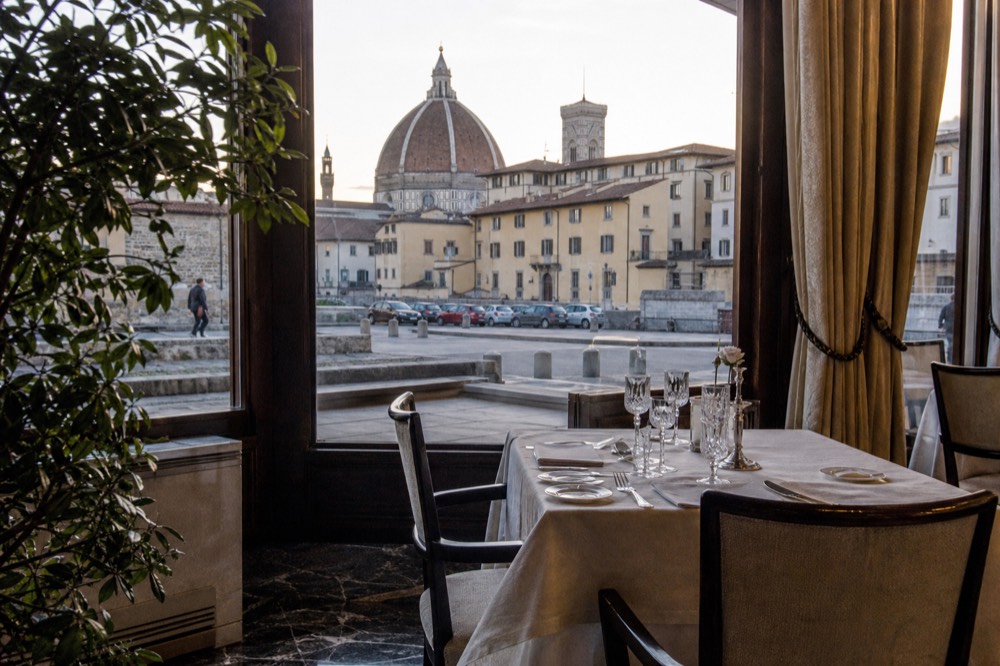
The wording comes straight from the restaurant's own menu and wine list page, which asks for elegant attire in order to keep the dining experience refined, and states plainly that flip flops and shorts are not permitted (Ristorante Santa Elisabetta). Note what it does not say. It does not ban jeans. Elegant attire with denim in it is a look plenty of guests pull off, and the two hard exclusions are flip flops and shorts, which is a summer-footwear rule more than a wardrobe philosophy.
The striking part is the company Santa Elisabetta keeps. The check covered the whole 2026 starred set: Enoteca Pinchiorri with three stars, Gucci Osteria da Massimo Bottura, Il Palagio at the Four Seasons, Borgo San Jacopo, Saporium, Atto di Vito Mollica and Luca's by Paulo Airaudo. Not one of them publishes a dress code. Neither does any rooftop bar, neither does any big trattoria. Those rooms are covered in full in our guide to the city's starred dining, and the practical takeaway for packing is simple: the single most formal dining experience in the city, a three-star tasting menu at Enoteca Pinchiorri, has no published dress requirement whatsoever.
| Venue | Publishes a dress code? | What it actually says |
|---|---|---|
| Ristorante Santa Elisabetta (2 stars) | Yes, on its own site | Elegant attire requested; flip flops and shorts not permitted |
| Enoteca Pinchiorri (3 stars) | No | Nothing published |
| Gucci Osteria da Massimo Bottura (1 star) | No | Nothing published |
| Il Palagio, Four Seasons (1 star) | No | Nothing published |
| Borgo San Jacopo (1 star) | No | Nothing published |
| Major trattorie (Za Za, Il Latini, Buca Mario, Sostanza, Mario) | No | Nothing published from any of them |
| Florence rooftop bars | No | No venue publishes a dress rule |
The table is the whole finding in one view. One venue, out of everything a visitor is likely to book, has put a rule in writing. If your itinerary includes it, pack accordingly: closed shoes and no shorts. If it does not, no restaurant in the city has told you what to wear.
Why do so many travellers think Italy has strict dress codes?
Three different things get merged into one false rule: restaurant policies, which barely exist; classification fields on booking listings, which are the platform's own labels rather than venue rules; and Italian public-decency law, which concerns behaviour on the street, not what you wear to a table. Separating them dissolves most of the anxiety.
The second source of confusion is the listing field. Two Florence rooftop venues carry "smart casual" and "business casual" labels on their booking listings, and those labels get repeated in travel articles as if they were house rules. They are not. They are the booking service's own classification, applied from a dropdown menu, and the venues' own websites publish no dress requirement at all. A reader who takes the label as a rule packs a jacket for a terrace where half the tables will be in shorts in July. Treat those labels as a vague hint about the vibe, nothing more.
The third source is the most understandable: Italian cities really do have rules about public behaviour, and they get reported abroad as "dress codes". Florence's urban police regulation, in the version published in 2024, prohibits "esibire parti intime del corpo in luoghi pubblici", exposing intimate parts of the body in public (Comune di Firenze). That is a law about walking around a city centre in swimwear or topless, and it belongs to the same family as the rules about drinking on cathedral steps. It is not a dining rule, it applies to everyone including locals, and it has no bearing on whether your trousers are denim.
Put the three layers side by side and the anxiety shrinks to its real size. One restaurant has a rule. Two listings have labels. One city law governs street behaviour. None of that adds up to "Italians have strict dinner dress codes", and the traveller who shows up in clean jeans and a collared shirt is, in practice, indistinguishable from half the Italian clientele.
Is a guided dinner the right move for your evening? If you would rather have someone else handle the table, this is the one to check first:
What should you wear to a steakhouse or trattoria in Florence?
Wear comfortable, tidy clothes you can sit in for two hours, because Florentine steak houses are casual, convivial rooms where locals dine in jeans most nights of the week. Closed, comfortable shoes matter more than fabric, since bistecca is priced by weight and ordered for the table, making it a long, social meal rather than a formal one.
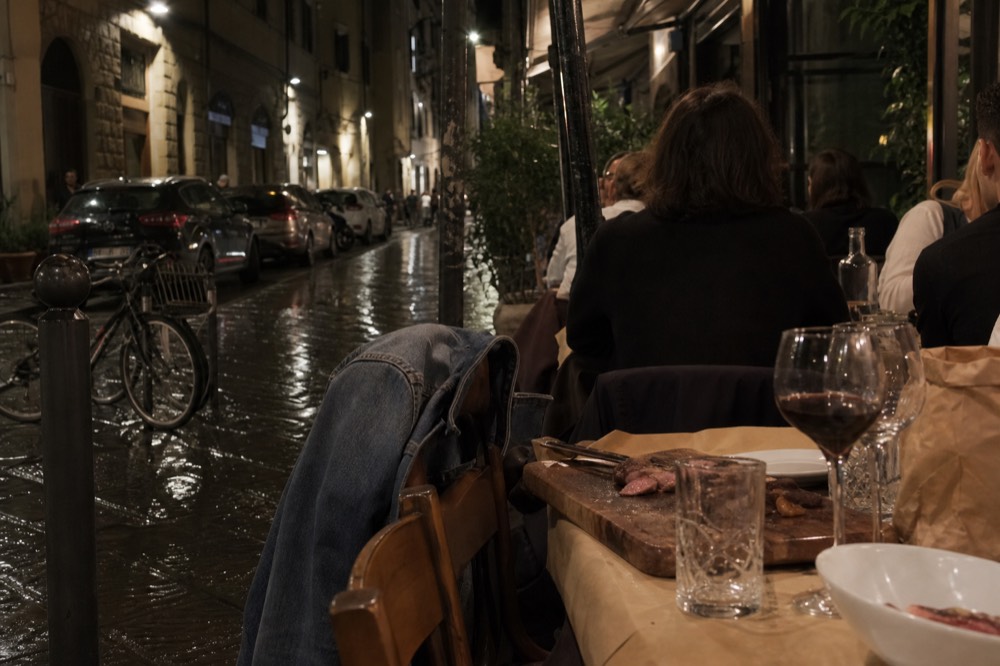
The bistecca alla fiorentina experience explains why. The steak is a single large cut, a T-bone from the loin, traditionally cut three to four fingers thick and typically weighing between about 0.9 and 1.2 kilograms in restaurants. It is grilled over wood or charcoal, served rare, and priced per kilo, so a table orders one and shares. That is a meal built around conversation and a second glass of Chianti, not around a dress code, and the rooms that serve it, from historic cellars near the Ponte Vecchio to big dining halls near the market, are furnished accordingly.
| Where you are eating | Realistic evening standard | Jeans with a decent shirt? |
|---|---|---|
| Neighbourhood trattoria | Whatever you wore to walk there | Yes, standard |
| Bistecca dining hall | Casual, family-style | Yes, the norm |
| Wine bar / enoteca | Casual, standing or small tables | Yes |
| Rooftop aperitivo | Slightly tidier, but no published rule | Yes |
| One-star and two-star dining rooms | Smart, understated; nothing published except one venue | Yes, if the overall look is elegant |
| Santa Elisabetta | Elegant attire; no flip flops or shorts | Yes, if the rest of the outfit is dressy |
Do rooftop bars and hotel restaurants care what you wear?
No Florence rooftop or hotel restaurant publishes a dress rule, so the honest answer is that nobody has told you what to wear. The only signals are booking-listing labels, one venue's smart-casual tag and another's business-casual tag, which are platform classifications rather than house policies. Practical clothing for a rooftop is governed by the wind, not the staff.
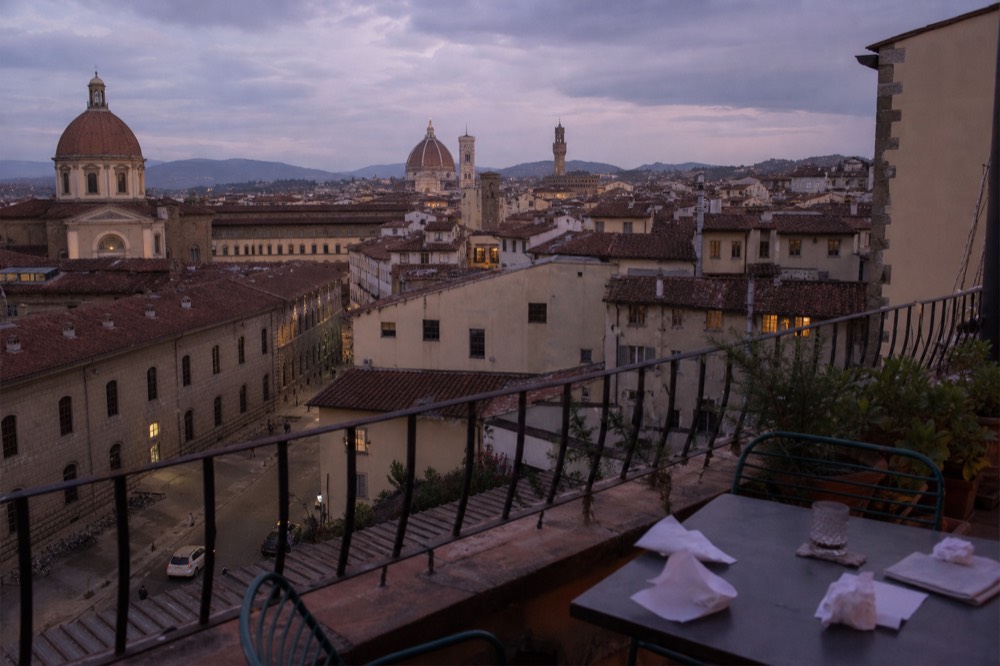
The sourced picture of Florence's rooftop dining is narrower than the listicles suggest, and it is worth knowing which venues actually stand on primary evidence. SE·STO on Arno at The Westin Excelsior is a full restaurant you have to contact directly rather than book through a network. Angel Roofbar & Dining at Hotel Calimala is the one with a real online booking system and a full dinner menu, open year-round and roughly midday to midnight. The Continentale's terrace is drinks and aperitivo only, seasonal, and its current status is unclear, so we do not send readers there until that is confirmed. Our guide to restaurants with a view in Florence covers the details.
None of these three publishes a dress code. The two labels that circulate, smart casual for the Westin terrace and business casual for the Calimala one, come from booking-listing fields rather than the venues, and should be read as atmosphere notes. In practice a rooftop in summer is full of people in linen and sandals, and a rooftop in winter is full of people in coats, and the staff's concern is whether you have a reservation, not what your legs are wearing. Bring a layer for the wind off the river; that is the genuinely useful rooftop dressing advice.
Hotel restaurants in general follow the same pattern as the starred set. Il Palagio at the Four Seasons, one of the city's starred rooms, publishes nothing about attire. The formal end of Florence dining has quietly decided that its guests can be trusted to dress for the occasion, and the single written rule in the city sits not with the grandest hotel dining room but with a two-star restaurant that worries about flip flops.
What about cooking classes and food tours, is there a dress code there?
No cooking class or food tour in Florence publishes a dress code, and the practical requirements come from the activity itself: closed shoes on a walking tour, an apron at a stove, and clothes you do not mind near flour or splattering fat. Jeans are, if anything, the ideal choice, being durable and heat-tolerant next to a grill.
The physical reality of these experiences does the work a policy would otherwise do. A market-and-cooking class spends its first hour on foot among the stalls of Sant'Ambrogio or the Mercato Centrale, then moves to a counter where you knead pasta dough by hand. A steak class puts you beside charcoal. A food tour is a walk with forks. In every case the outfit that serves you best is sturdy trousers and closed shoes, which is to say: the jeans question answers itself before the class begins. You can read more about the formats in our guide to Florence cooking classes.
This is the general pattern across the whole site's tour roster, from the pasta class at $44 per person (checked September 2026) up to the private food tours: operators specify what you will cook, how long it lasts and how many people will be there, and none of them specifies what you will wear. The anxiety about Italian dinner dress exists almost entirely in the space between restaurant doors and guidebook prose, not in anything the venues and operators themselves have written.
Whichever of these formats fits your evening, the trio below covers the range from a guided walk with a steak dinner to a hands-on class at the grill:
The recurring questions all have the same shape: readers want a rule, and the evidence keeps offering a norm. Jeans are fine, exactly one Florence restaurant has a written dress code, listing labels are not venue rules, and Italian law governs street behaviour rather than dinner attire. The answers below give the specifics for each case.
Common questions about dinner dress in Italy
Can I wear jeans to dinner in Italy?
Yes. Jeans are common at dinner tables across Italy, including well-regarded trattorie and wine bars, and no Italian law or widely published restaurant rule forbids them. The standard being applied is tidy versus sloppy, not denim versus wool, and clean jeans with a proper shirt pass everywhere except the small number of formal rooms that request elegant attire.
Do any Florence restaurants have a dress code?
Exactly one that publishes one: Ristorante Santa Elisabetta, the two-star dining room at the Hotel Brunelleschi, which requests elegant attire and excludes flip flops and shorts. Every other starred restaurant, rooftop bar and major trattoria checked on 2026-09-06 publishes nothing about attire.
Will a Michelin-starred restaurant in Florence turn me away for jeans?
There is no published basis for that. None of Florence's starred restaurants, including three-star Enoteca Pinchiorri, publishes a dress code. The only written rule in the starred set is Santa Elisabetta's, and even that bans flip flops and shorts rather than denim.
What is the difference between a dress code and the "smart casual" label on a booking listing?
A dress code is a rule the venue publishes and can enforce at the door. A listing label is a classification applied by the booking service, not by the venue, and Florence's two labelled rooftop venues publish no dress requirement on their own sites. Treat the label as a vibe hint, not a rule.
Does Italian law say anything about what you wear?
City regulations govern public behaviour, not restaurant dining. Florence's urban police regulation prohibits exposing intimate parts of the body in public places, which is a street-behaviour rule aimed at things like walking the centre in swimwear. It says nothing about dinner attire.
What should I wear to a bistecca dinner in Florence?
Comfortable, tidy clothes and closed shoes. Bistecca alla fiorentina is a shared, weight-priced cut typically served at 0.9 to 1.2 kilograms, which makes it a long social meal in a casual room. Jeans are standard evening wear in exactly those dining rooms.
Choose Your Florence Food Experience
Initial editorial recommendation
Evening Steak And Wine Walk
Combine a walk through Florence with a sit-down Florentine steak dinner and other tastings. Check your travel date before arranging your other meals.
3.5 hours, English guide. Hotel transfers and optional tips excluded. Walking required; dietary needs need advance confirmation.
Compare The Formats And Adjust Your Choice
Choose clothes for the actual venue and activity. Food walks involve walking; cooking classes involve working at a kitchen bench.
Florentine Steak Cooking Experience: Cook certified Chianina steak with a chef and enjoy it in a three-course meal with Chianti wine. 1.5 hours, English available. Hands-on cooking and a three-course meal included. Confirm individual dietary and access requirements with the operator.
Pizza Class With Gelato And Wine: Make your own pizza and watch an artisan gelato demonstration, then enjoy pizza and unlimited gelato. 3 hours, English, maximum twenty. Via Panicale 43R, arrive 15 minutes early. Wine for adults, soft drinks for children. Children need an adult; not suitable for coeliac guests.
No verified recommendation meets these choices. Adjust the time or experience, or reset. For dietary, age or access requirements, obtain the operator's confirmation before booking.
Choose a date to see Viator's scheduled departures. Availability and final price are confirmed on Viator.